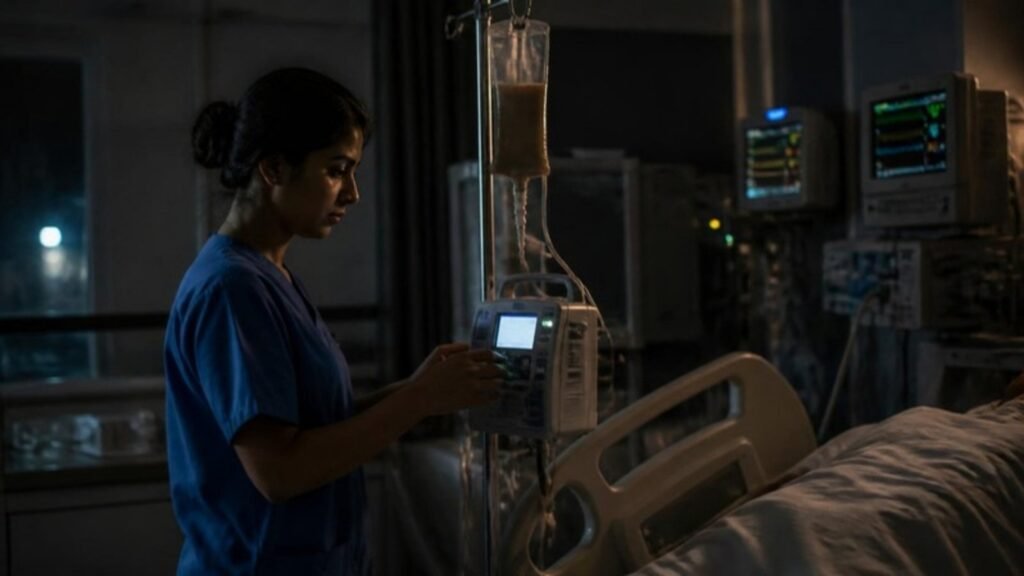
There is a phrase I hear in intensive care units across India that I would like to retire: “Ryles feed started.”
It sits in the notes like a full stop, as though the work were done once the tube was in. In truth it is a comma at best. Putting a tube in is easy. What goes down it, how much, how often, and whether any of it actually reaches the patient is where the patient is helped or harmed.
This is an opinion piece, and I’ll be plain about my opinion. I think nutrition in many Indian ICUs, including some very good ones, is treated as nursing housekeeping rather than therapy. I think that costs patients muscle, time and sometimes their lives. And I think the fixes are mostly not expensive.
What the guidelines actually say
The European Society for Clinical Nutrition and Metabolism (ESPEN) intensive care guideline is a reasonable reference point. It makes several recommendations that I find most ICUs agree with on paper:
- If a critically ill patient cannot eat, start enteral (tube) feeding early, generally within 48 hours, rather than waiting.
- Don’t rush to full feeds on day one. Build up over the first few days and avoid overfeeding in the earliest phase.
- Aim to deliver adequate protein progressively (around 1.3 g/kg/day in the guideline), because critical illness strips muscle at an astonishing rate.
Nothing controversial there. The problem is the distance between the prescription and the patient.
Where feeds disappear
Audits from ICUs around the world keep finding the same thing. Patients receive substantially less nutrition than is prescribed, and the gap grows in exactly the patients who are sickest. In my experience Indian ICUs are no exception. The feed is stopped:
- for a scan, and not restarted for six hours;
- before a procedure that is then postponed to tomorrow;
- because of a “high aspirate” that would not have triggered a pause under current thresholds;
- because the night shift is short of hands, and a two-hourly bolus becomes a four-hourly one.
Each interruption is defensible on its own. Added together over a week, they can mean a patient who was prescribed full nutrition has had a fraction of it, and nobody has added it up.
The kitchen-blend question
In many Indian hospitals, tube feeds are still prepared in the hospital kitchen or brought from home: rice water, dal water, milk, sometimes a blended meal. I’m not going to sneer at this. It’s affordable. Families find comfort in it. And a carefully planned, hygienically made blended feed can be a reasonable option for some stable patients.
But I’d ask colleagues to be honest about three problems.
We rarely know what’s in it. The protein and energy in a jug of “feed” can vary hugely from batch to batch, and from cook to cook.
It is easily contaminated. Feeds made in an open kitchen and hung at room temperature in a warm ward are a perfect broth for bacteria, in patients whose defences are already down.
It blocks tubes. Every blocked tube is a reinsertion, an X-ray, a delay, and sometimes a misplaced tube.
For a critically ill patient in the first week, I believe feeds should be specified, measured and safe. That does not have to mean expensive. It means someone knows what the patient is getting.
Three changes I would make tomorrow
1. Record what was delivered, not just what was prescribed. Add one line to the ICU chart: feed delivered in the last 24 hours, in ml and as a percentage of target. What gets counted gets attention. This single line changes ward behaviour faster than any lecture I have given.
2. Write a feeding protocol and let nurses run it. Start time, rate, how to step up, when to pause, when to restart, and what “high aspirate” means. Nurses, armed with a protocol, deliver more nutrition than nurses waiting for a doctor’s order. The evidence on this is consistent and so is my experience.
3. Bring the dietitian onto the ward round. Not called in on day five because the patient “looks thin”, but present on day one, alongside the intensivist and the physiotherapist. The ICU survivors of tomorrow need their muscle as much as their lungs.
Why this matters beyond the ICU
We have become very good, in India, at keeping people alive through critical illness. The next frontier is what kind of life they go home to. A patient who leaves the ICU unable to stand, swallow or hold a cup has survived, but has a long road ahead. Nutrition is one of the few things we control from day one that shapes how long that road will be.
So let’s stop writing “Ryles feed started” as though it were the end of the sentence. It is the beginning of a treatment, and we should measure it like one.
Reference
- Singer P, Blaser AR, Berger MM, et al. ESPEN guideline on clinical nutrition in the intensive care unit. Clin Nutr. 2019;38(1):48–79 (and the 2023 update).