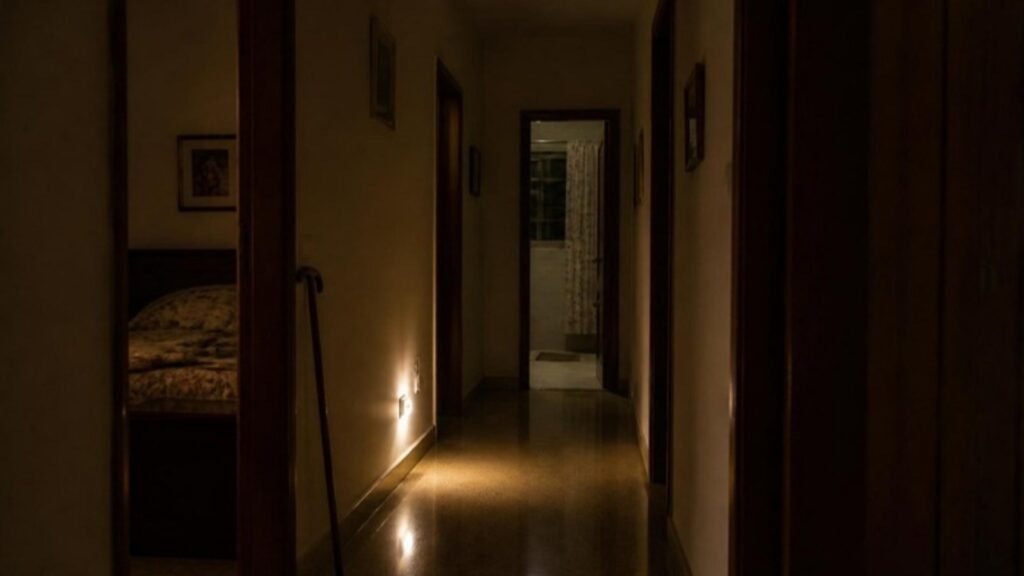
2:47 a.m. He wakes because his bladder tells him to. It’s the second time tonight. He is 79, takes a water tablet for his blood pressure in the evening “so I don’t forget”, and had a cup of tea at nine.
2:48 a.m. He sits up quickly, because he’s worried he won’t make it. His blood pressure, which falls a little when an older person stands suddenly, takes a few seconds to catch up. The room tilts.
2:48 a.m. He doesn’t switch on the light, so as not to wake his wife. His glasses are on the side table. The path to the bathroom crosses a loose rug and the edge of a step down.
2:49 a.m. He’s half asleep, hurrying, a little dizzy, in the dark.
You can probably guess the next line. I’ve read it in many admission notes: “Found on the bathroom floor by wife at 3 a.m. Unable to get up. Suspected hip fracture.”
The connection nobody makes
When an older person falls, we look at their bones, their balance, their eyesight, their medicines. All rightly. But we rarely ask the simple question: where were you going?
Very often the answer is the toilet, at night.
Waking at night to pass urine is called nocturia. It is very common with age. A systematic review and meta-analysis published in the Journal of Urology in 2020 pooled observational studies and found nocturia was associated with about a 20% higher risk of falls, and possibly a higher risk of fractures too (the fracture estimate was less certain). That may sound modest. Across an ageing population, and for one man at 2:48 a.m., it is not.
Why are you waking up?
Nocturia is not one condition. It’s a symptom with several possible causes, and the cause decides the treatment.
- Making too much urine at night. Common causes are evening fluids, tea or alcohol late in the day, a water tablet taken at the wrong time, poorly controlled diabetes, and heart failure. So are swollen ankles: fluid that pooled in the legs during the day returns to the circulation when you lie down, and the kidneys pass it out at night.
- A bladder that holds less, or complains early. This happens with overactive bladder, and in men with an enlarged prostate.
- Poor sleep that wakes you, and then you notice the bladder. Sleep apnoea, the loud snoring with pauses in breathing, is an under-recognised cause of night-time urination.
A simple bladder diary sorts out much of this. For three days, write down every drink (what and how much), and every visit to the toilet, with the time and roughly how much you passed. Bring it to your doctor. It’s worth more than most blood tests in working out nocturia.
Our 79-year-old, rewritten
Let’s run the night again, with a few changes:
His water tablet moves to the morning, after a word with his doctor. Most of the extra urine now comes in the daytime.
Tea after 6 p.m. becomes the exception, not the habit. He drinks well during the day, then tapers off in the evening.
He puts his feet up for an hour in the afternoon, so the ankle fluid returns and is passed before bedtime, not at 3 a.m.
His snoring is finally investigated.
He now wakes once, not twice or three times.
And when he does wake:
- He sits on the edge of the bed and counts to ten before standing, giving his blood pressure time to adjust.
- A small motion-sensor night light along the floor shows the way without waking his wife.
- The rug is gone. The step has a contrasting strip and a grab rail.
- His glasses and stick are within reach.
- For a man who also has urgency, a urine bottle or commode by the bed on bad nights removes the hurry altogether.
No single change is dramatic. Together, they turn a dangerous journey into an ordinary one.
A note to my colleagues
When you see an older patient after a fall, ask about night-time urination. When you see one with nocturia, ask about falls. And look hard at the medicine list: evening diuretics, sedatives and sleeping pills, and drugs that drop blood pressure on standing. Each can be a link in this chain.
For families, the message is simpler. If your parent is getting up several times a night, don’t just accept it as age. It’s worth a conversation with the doctor, and a walk along the route to the bathroom with the lights off, to see it as they do.
Reference
- Pesonen JS, Vernooij RWM, Cartwright R, et al. The impact of nocturia on falls and fractures: a systematic review and meta-analysis. J Urol. 2020;203(4):674–683.