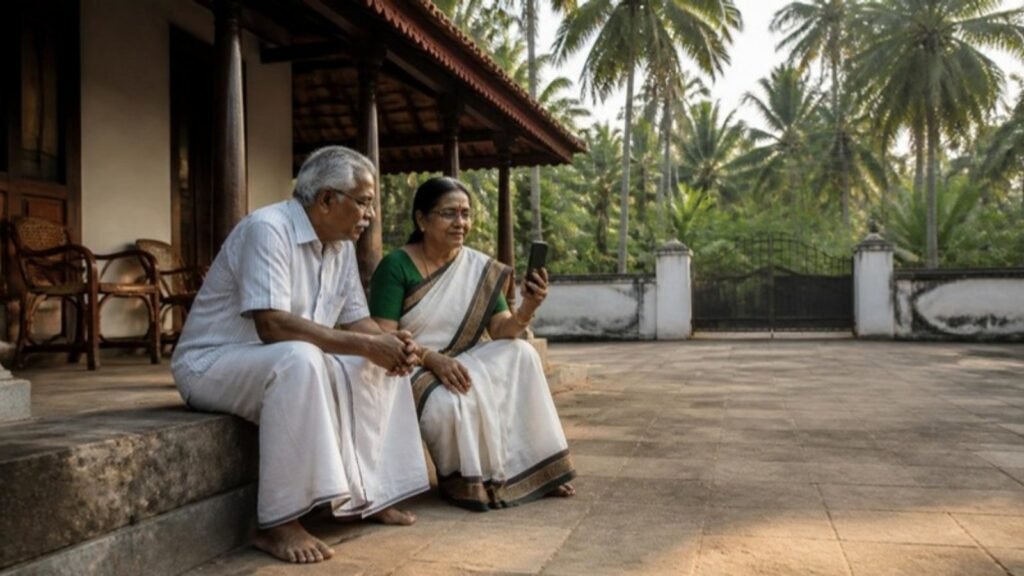
Drive through almost any village in central Kerala in the afternoon and count the houses with a padlock on the gate. Then count the ones where an older couple sits on the verandah, phone in hand, waiting for the evening video call from Dubai, Toronto or Bengaluru.
I’ve been making that informal count for years. It’s not a statistic. But it tells me, more vividly than any table, what has happened to our state.
A success story, first
Let me say clearly: Kerala’s ageing is a triumph before it is a challenge. We are ageing because we did things right. Women are educated. Infant mortality is low. Families are small by choice. Public health reached villages early. People live long. According to the UNFPA’s India Ageing Report 2023, a woman in Kerala who reaches 60 can expect, on average, about 22 more years of life, around four more than a man of the same age.
Long lives were the goal. We achieved it. The question is what we do with all those extra years.
The numbers
About one in six people in Kerala is now over 60, around 16.5% in 2021 by government estimates, against roughly 10% for India as a whole. The state’s share is projected to pass one in five by the mid-2030s. India is following the same road, a generation behind: the national share of people over 60 is expected to reach about 15% by 2036 and around 20% by 2050.
Within those numbers are three shifts I think deserve more attention than they get.
The oldest old are the fastest-growing group. Nationally, the population over 80 is projected to grow by nearly 280% between 2022 and 2050. People over 80 are the most likely to need daily help with dressing, bathing, eating and getting to the toilet.
Old age is increasingly female, and often widowed. Because women outlive men, many older women spend their last decade or two as widows, often with less income and fewer assets than men of their age.
The family is smaller and further away. The joint family that once absorbed the care of elders is thinning out. Children have migrated, within India and abroad, often to send money home. The India Ageing Report notes that around a fifth of older Indians live alone or only with a spouse. In Kerala, with its long history of migration, the locked gates tell me the share is higher in many villages.
What this means for health
As a geriatrician, I see the clinical side of these shifts every day.
Multiple long-term conditions are the norm, not the exception. National surveys find most older Indians live with at least one chronic disease. Many of my patients have three or four, and a bag of medicines to match. Our health system, organised by specialty and by single disease, struggles with a person who has diabetes, heart failure, arthritis, failing memory and a weak bladder all at once.
The quiet conditions decide independence. Malnutrition, muscle loss, poor swallowing, incontinence, falls, depression. These rarely make headlines, but they decide whether an 80-year-old lives in her own home or doesn’t. They are also, very often, preventable or treatable.
Care has become a labour market. Home nurses, care agencies and “old age homes” have multiplied, with very uneven training and almost no standard of quality. Families buying care at a distance often have no way to judge it.
What a good ageing society needs
I don’t have a master plan, and I’m wary of anyone who claims one. But from where I sit, five things seem clear.
1. Geriatric thinking in primary care. Every family health centre should be able to screen for frailty, falls, nutrition, memory, mood and continence. The tools are simple. What’s missing is the habit.
2. Prevention that starts at 50, not 80. Muscle, bone and pelvic floor health are built in midlife. So is the habit of moving every day.
3. Support for those who care. That means unpaid family carers, usually women, and paid carers who deserve proper training and fair conditions.
4. Homes and towns built for older bodies. Grab rails, night lights, ramps, toilets at the right height, pavements and benches. Kerala’s local bodies, with their tradition of participatory planning and initiatives like age-friendly panchayats, are well placed to lead here.
5. Technology that serves, not replaces. Video consultations, medicine reminders, fall alerts and remote monitoring can help families who live far away. But a screen cannot cook, lift or hold a hand. Technology should extend human care, never substitute for it.
Back at the verandah
I think often of an elderly couple I visited near Kottayam. Both children abroad, both of them doing their best. The husband had begun to forget things. The wife was quietly struggling with her knees and her bladder, and with the work of caring for him.
“We are not lonely,” she told me firmly. “Our children call every day.”
And they did. But when I asked who would help if she fell, she looked at the phone in her hand for a long time.
That pause is Kerala’s challenge in a single moment. We built a society where people live long. Now we have to build one where they are not alone when they need help.
Sources
- UNFPA and International Institute for Population Sciences. India Ageing Report 2023.
- Ministry of Statistics and Programme Implementation. Elderly in India 2021.
- Longitudinal Ageing Study in India (LASI), Wave 1, 2017–18.