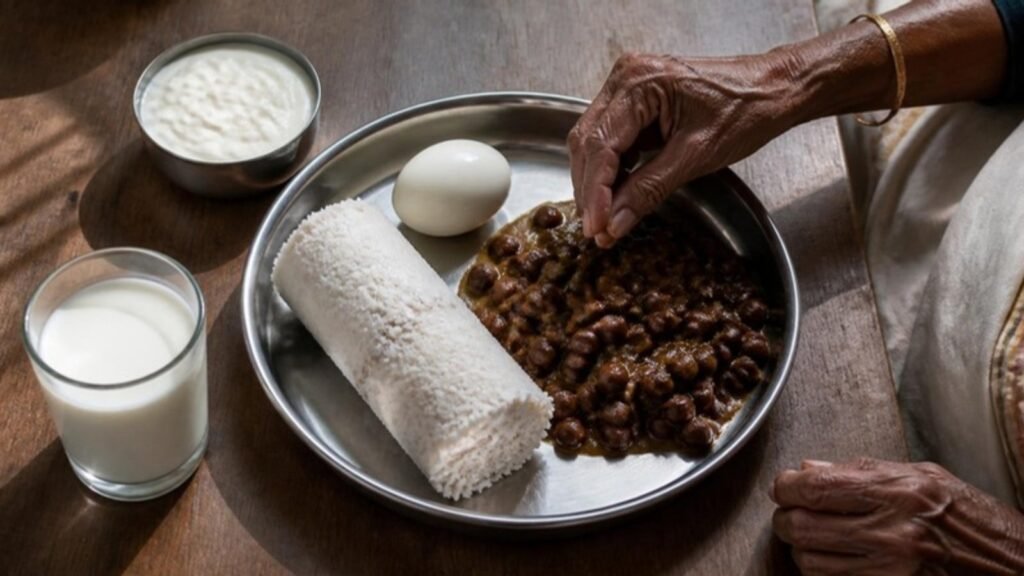
A few years ago I asked a patient’s daughter to do something slightly odd. For one ordinary day, I asked her to write down everything her mother ate. Not calories, nothing clever. Just what went in and roughly how much.
Her mother was 68, weighed about 55 kg and was “eating well”, by the family’s account. She had three meals and tea twice. Nobody was worried about her diet. They were worried that she had become slow on the stairs.
When we sat down with the list and a reference book, her protein for the day came to about 32 grams.
For a woman of her size and age, a sensible target is somewhere between 55 and 65 grams. She was eating roughly half of what her muscles needed, on a day everyone considered good.
The arithmetic is simple
For healthy older adults, an international expert group (PROT-AGE) suggested 1.0–1.2 g of protein per kilogram of body weight per day. They suggested 1.2–1.5 g/kg for those with acute or chronic illness. European geriatric nutrition guidance (ESPEN) uses at least 1 g/kg/day as the floor. These are higher than the figures many of us learned for younger adults. Older muscle is less responsive to protein, so it needs a bigger signal.
So multiply your weight in kilograms by 1 to 1.2. At 60 kg, that’s 60–72 g a day. At 70 kg, 70–84 g.
An important exception: if you have chronic kidney disease that is not on dialysis, your target may be lower. Please ask your doctor before increasing protein.
Where it goes missing
In most Kerala homes I visit, the plate is built around rice, and that is fine. Rice gives energy, and it is the food of comfort and memory. But a cup of cooked rice carries only about 4 grams of protein. The fish curry, the thoran, the sambar are the supporting cast, and in older appetites the supporting cast is the first thing left on the plate.
Then there’s breakfast. It’s often the meal with the least protein, and for older people often the meal they eat best.
One day, rebuilt
Here is how that 32-gram day looked, and what we changed. The numbers are approximate. Home recipes and portions vary.
| Meal | Before | After |
|---|---|---|
| Breakfast | 2 pieces of puttu with banana (≈ 7 g) | Puttu with a small bowl of kadala curry (≈ 13 g) and a glass of milk instead of black tea (+6 g) |
| Mid-morning | Tea and a biscuit (≈ 1 g) | Tea with milk and a handful of roasted peanuts (≈ 8 g) |
| Lunch | Rice, sambar, cabbage thoran (≈ 12 g) | Same, plus one piece of fish or an egg (+7–15 g) and a cup of moru (buttermilk) (+3 g) |
| Evening | Tea and a banana fritter (≈ 2 g) | Tea with milk and a small bowl of boiled cherupayar (green gram) sundal (≈ 8 g) |
| Dinner | Kanji with pickle (≈ 6 g) | Kanji with payar or a little dal and a spoon of curd (≈ 12 g) |
| Total | ≈ 30–35 g | ≈ 60–70 g |
Notice what we did not do. We didn’t take away her rice. We didn’t invent new recipes. Almost every change was an addition she already knew and liked, placed where her appetite was strongest.
Three principles I use
1. Spread it out. Muscle seems to respond best when each main meal carries a decent dose of protein. Researchers often quote 25–30 g per meal. Most Indian diets back-load protein into lunch and starve breakfast and dinner. Even out the day.
2. Use the meals people actually eat. If your father eats a full breakfast and picks at dinner, put the egg at breakfast. Nutrition is not a fixed rule. It has to fit the person in front of you.
3. Liquids count. When chewing is difficult or appetite is poor, milk, buttermilk and curd-based drinks deliver protein with less effort than solid food.
What about protein powders?
For someone who can eat a varied diet, food comes first. It brings other nutrients and pleasure along with the protein. For people who are unwell, recovering, or simply unable to eat enough, a supplement can bridge the gap. If you are in that situation, please involve a doctor or dietitian, so the choice matches your kidneys, your blood sugar and your medicines.
Her stairs
She started doing chair-stands with her granddaughter in the evenings, a game for one and therapy for the other. Three months later she was taking the stairs at her own pace again. The food alone didn’t do that, and neither did the exercise alone. Muscle needs both: a reason to grow, and the material to grow with.
References
- Bauer J, Biolo G, Cederholm T, et al. Evidence-based recommendations for optimal dietary protein intake in older people: a position paper from the PROT-AGE Study Group. J Am Med Dir Assoc. 2013;14(8):542–559.
- Volkert D, Beck AM, Cederholm T, et al. ESPEN guideline on clinical nutrition and hydration in geriatrics. Clin Nutr. 2019;38(1):10–47.