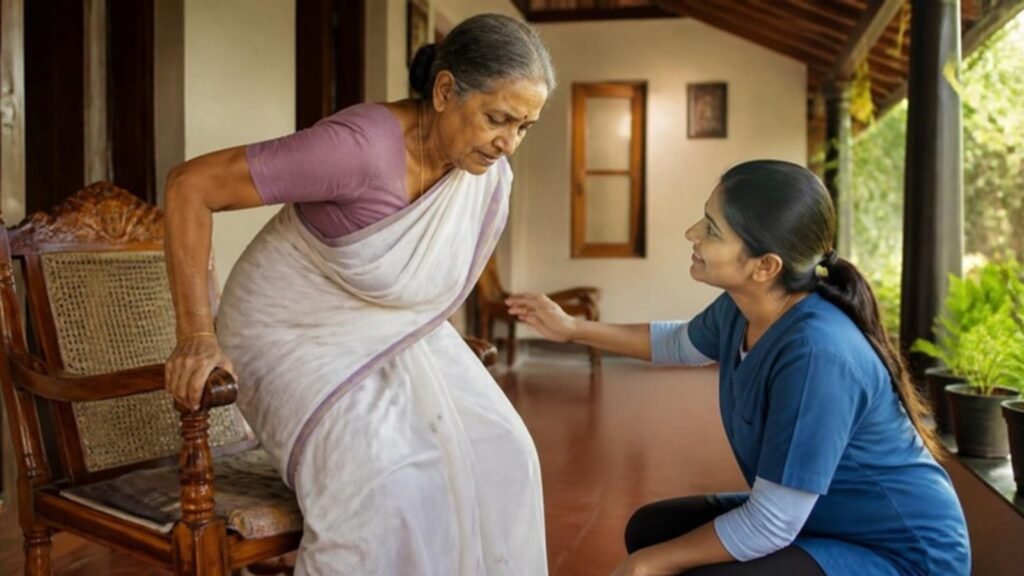
Most of what I know about how people experience ageing muscle, I learned from the questions they ask at the end of a consultation, usually with one hand already on the door. Here are the ones I hear most, with the answers I wish I had more time to give.
“Doctor, my legs have become weak. Isn’t that just age?”
Partly, and that “partly” matters a great deal.
We all lose some muscle as we get older. But there is a point where the loss becomes a condition in its own right. It has a name, sarcopenia, and doctors can measure it and treat it. It is not a polite word for “old”. It means muscle strength and muscle mass have fallen far enough to threaten what you can do: climb steps, rise from the floor after prayers, carry a bucket, get to the toilet in time.
The difference between “age” and “sarcopenia” is the difference between something you accept and something you work on.
“How would you even know I have it?”
The tests are humble. The Asian Working Group for Sarcopenia updated its criteria in 2019 so that Asian bodies are measured against Asian reference values, not European ones. In clinic I usually start with three things.
Your grip. You squeeze a handheld dynamometer. Below 28 kg for men or 18 kg for women counts as low strength.
Your chair. You stand up from a chair five times, arms folded, as quickly as is safe. Twelve seconds or more points to a problem. So does a walking speed below 1 metre per second over six metres.
Your calf. A tape measure around the widest part of the calf. Under 34 cm in men or 33 cm in women is a reason to look further.
If strength or performance is low, we call it possible sarcopenia. In a community or primary-care setting, that alone is enough to start doing something. In hospital we can confirm it by measuring muscle mass with a body-composition scan. You don’t need an expensive machine to raise the alarm, though. A chair, a tape and a stopwatch will do.
“I’ve lost weight. Shouldn’t that make walking easier?”
This one breaks my heart a little, because it sounds so reasonable.
When older adults lose weight without trying, a large share of what they lose is often muscle. You can even lose muscle while keeping, or gaining, fat. We call that sarcopenic obesity, and in India I see it far more often than most people expect. The scale tells you very little. Your ability to get out of a chair tells you much more.
“Should I rest more, then? My knees hurt.”
I understand the instinct. But muscle that is not asked to work is quietly dismantled. Rest is good for an injury. As a lifestyle, it is a slow way to lose independence.
The single most effective treatment for sarcopenia is resistance exercise: work that makes the muscle push against something. That needn’t mean a gym. It can be:
- sit-to-stands from a firm chair, ten at a time, a few times a day;
- wall push-ups;
- a water bottle or a bag of rice lifted overhead;
- heel raises holding the kitchen counter;
- step-ups on the bottom stair, with the rail.
Two or three days a week, gradually harder. If your knees are painful or your balance is uncertain, a physiotherapist can adapt these for you. Doing them carefully is far better than not doing them at all.
“And food? My appetite is small now.”
Muscle is built from protein. Older muscle needs more of it to respond, a phenomenon called “anabolic resistance”. Many expert groups now suggest that healthy older adults aim for roughly 1.0–1.2 g of protein per kilogram of body weight per day, and more during illness or recovery, unless your doctor has advised otherwise (for example in advanced kidney disease).
The catch with a small appetite is that a typical South Indian plate is mostly rice, with protein sitting at the edges. I’ve written a separate piece on how to move protein to the middle of the plate without adding much bulk. The short version: spread it across the day, and make sure every meal has some.
“Is there a tablet for it?”
Not yet one that I would recommend in place of exercise and food. Vitamin D matters if you are deficient, and it is worth checking. Some supplements may help people who cannot meet their needs through food. But I’ve never met a capsule that could do what ten slow chair-stands a day can do.
“Is it too late for me? I’m eighty-four.”
No. This is the question I most enjoy answering.
Muscle responds to training well into the ninth and tenth decades of life. The gains are smaller and slower than at thirty, but they are real, and they show up where they matter: the stairs, the bathroom, the walk to the gate. I have watched people in their late eighties go from needing a hand to stand to doing it alone, just by turning a chair into a training partner.
So no. Your legs are weak, and that can change.
Reference
- Chen LK, Woo J, Assantachai P, et al. Asian Working Group for Sarcopenia: 2019 consensus update on sarcopenia diagnosis and treatment. J Am Med Dir Assoc. 2020;21(3):300–307.
- Bauer J, Biolo G, Cederholm T, et al. Evidence-based recommendations for optimal dietary protein intake in older people (PROT-AGE). J Am Med Dir Assoc. 2013;14(8):542–559.