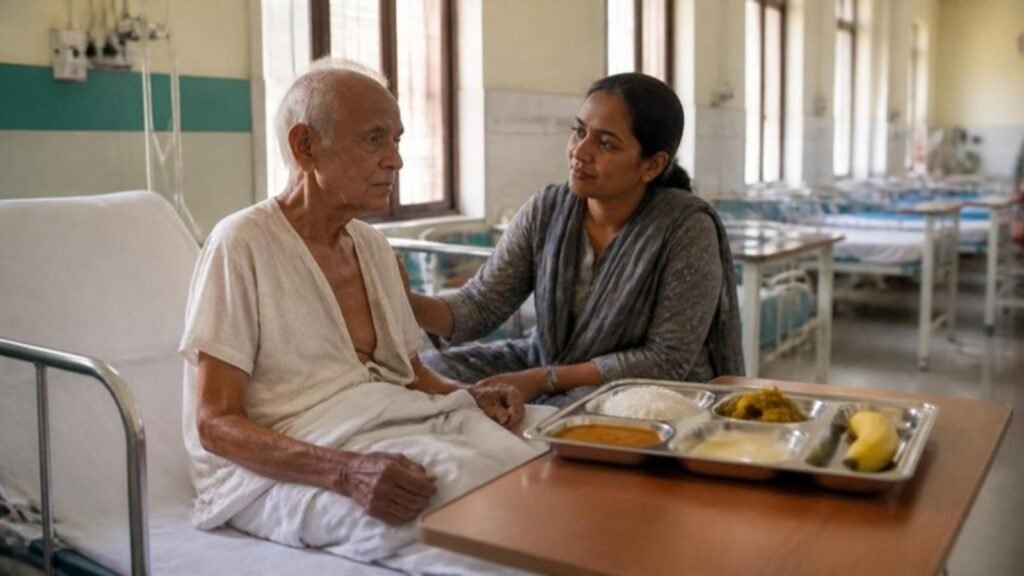
Let me tell you about a man I will call Appachan. The name isn’t his, and I’ve changed enough details that he wouldn’t recognise himself.
He was eighty-one, a retired schoolteacher from a village outside Thrissur. He came in with a chest infection. The infection responded well to antibiotics. By day four his fever was gone, his oxygen was normal, and the team was talking about discharge.
But on day four he could not stand up without two people holding him. When he came in he had walked from the car to the casualty door.
No one had written anything wrong in his notes. His chest X-ray was clearing. His blood counts were improving. The single thing nobody had written down was that, for four days, his lunch tray had gone back to the kitchen almost full.
The tray that comes back
I have spent much of my working life watching trays come back. It is one of the most informative things you can watch in a hospital, and one of the least recorded.
A study of 262 older adults admitted to five private hospitals in India found that about 31% were at risk of malnutrition on admission, and that this rose to 44% during the hospital stay. More than a quarter ate half or less of their main meal (Wright et al., Nutrition & Dietetics, 2021). So hospital itself made the problem worse. People came in at risk and went home more at risk.
That should trouble all of us, because we are the ones running the hospitals.
Why “hidden”?
Because malnutrition in an older person rarely looks like the pictures in textbooks. Appachan was not skeletal. He had a slight paunch, the kind many men of his generation have. His weight on admission was “normal”. What he had lost, over the previous year, was muscle. He was walking more slowly, his grip on the umbrella was weaker, and his collar had loosened. His family had put it down to age.
Then came four days of fever, bed rest and eating almost nothing. In an older body that is enough to tip someone from “managing” to “unable to manage”.
Older adults lose muscle quickly when they are immobile and not eating. Bed rest alone does damage, and missed meals do more. Put the two together during an acute illness and the loss is often greater than anything the infection did.
It is not that nobody cares
I want to be fair to my colleagues. Nurses are stretched thin. Doctors are trained to fix the presenting problem, and they fix it well. Dietitians, where hospitals employ them, often cover several hundred beds each. Families bring food from home, which is wonderful, but nobody records how much of it is eaten.
The gap sits between people. Everyone assumes someone else is watching the plate.
Does feeding people properly actually change outcomes?
For a long time the honest answer was “probably”. Since 2019 we have something firmer. The EFFORT trial in Switzerland randomised 2,088 medical inpatients at nutritional risk, with an average age of 72. One group got individualised nutrition support: a target for energy and protein, a plan to meet it, and someone checking. The other got standard hospital food.
At 30 days, the supported group had fewer serious adverse outcomes (23% against 27%). They also had lower mortality (about 7% against 10%) (Schuetz et al., The Lancet, 2019).
Think about that. The intervention was not a new drug. It was a plan for food, and somebody following it.
What I would ask, if it were my father in that bed
I don’t think families should have to become clinicians. But a few questions, asked politely, can shift what happens on a ward.
- “Has anyone screened him for nutrition risk?” Simple tools such as the MNA-SF or MUST take a few minutes. If the answer is no, ask whether it can be done.
- “How much is he actually eating?” Keep your own rough note: a quarter of the plate, half, all of it. Three days of “a quarter” is a signal, not a mood.
- “Can he be weighed?” On admission and once a week is a reasonable minimum.
- “Can he get out of bed today, even to a chair?” Eating sitting up at a table is different from eating propped against a pillow. So is keeping the legs working.
- “Is there a dietitian who can see him?” If he is losing ground, he may need an energy and protein target and a written plan to reach it, not just “a soft diet”.
Appachan, afterwards
We kept him four extra days. The ward started recording his intake. The dietitian adjusted his meals to things he would actually eat. His daughter brought kanji with a little payar in the mornings, because that was what he wanted. A physiotherapist had him walking to the window and back twice a day.
He went home walking with a stick. Six weeks later his daughter told me he was back to his evening walk to the junction. He was slower than before, but he was going.
I have no trial data for Appachan. I only have the tray, and the fact that, once someone was watching it, it came back emptier.
If you take one thing from this: in an older person, not eating is never a minor detail. It belongs in the notes, at the bedside, in the handover. And very often it is the thing that decides whether they go home on their own feet.
References
- Wright C, Shankar B, Marshall S, et al. Prevalence of malnutrition risk and poor food intake in older adults in Indian hospitals: a prospective observational nutritionDay study. Nutrition & Dietetics. 2021;78(2):135–144.
- Schuetz P, Fehr R, Baechli V, et al. Individualised nutritional support in medical inpatients at nutritional risk: a randomised clinical trial (EFFORT). The Lancet. 2019;393:2312–2321.